

 41:02
41:02This recording is not available yet.
Categories
Governance, Risk & LeadershipSecurity Program & StrategyIdentity & AccessNetwork Security & Zero TrustZero Trust
Sponsored by
About this session
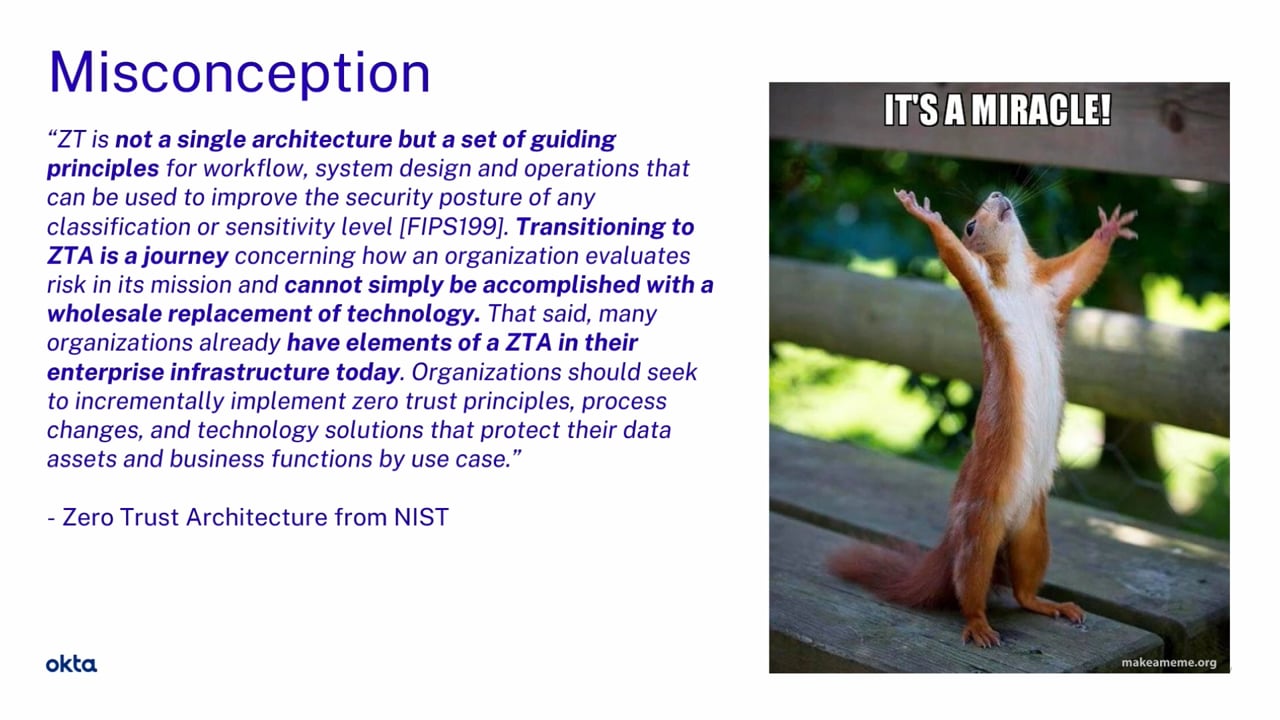
Antoine Paris and Quentin Guiget, consultants at Linkbynet Cyber Security (part of Accenture), lay out how to start a Zero Trust programme without drowning in it. They frame Zero Trust as a mindset, not a product: the perimeter model no longer holds once identities, devices and applications are spread across SaaS and cloud, so every access request must be evaluated in real time from signals about the identity, device, location and target sensitivity, with automated responses such as step-up MFA or reduced privileges. They set out eight guiding principles (a consolidated IAM, an authentication catalogue per population, data and asset classification, retained network segmentation, behavioural analytics, automation, least privilege and change management) and a three-step approach: define the target, weigh strategies with rough costing, then steer the programme and its sub-projects. The second half is a case study of an international transport group with 200,000 identities, 700 SSO applications and five legally independent entities, whose IAM rebuild they lead: governance in work packages, standard protocols, a shared multi-domain IAM service, and an 'accédant' object separating a person's single identity from the per-company access records that carry entitlements.
Venez écouter les experts Linkbynet pour découvrir leur retour d'expérience sur la mise en place d'une
démarche Zéro Trust. Description conférence : Vous avez lancé, ou envisagez de lancer, un projet stratégique de mise à niveau de la sécurité de votre système d'information en vous basant sur le modèle du Zéro Trust ? Vous connaissez les principes du Zéro Trust mais vous avez de la difficulté à identifier les chantiers nécessaires à leur mise en application ? Fort de son expérience, Linkbynet vous invite à venir découvrir à travers cette allocution quelles sont les questions à se poser pour mettre en place une solution de Zéro Trust résiliente et les prérequis qui vous permettront d'appliquer les principes du Zéro Trust. Nos experts vous partageront à cette occasion un cas client réalisé pour un acteur majeur du secteur des transports. Cette présentation virtuelle s’adresse aux responsables TI & sécurité, aux analytes et aux architectes
qui sont impliqués dans les sujets de la sécurisation des systèmes d'information.
Key takeaways
- Treat Zero Trust as a multi-year programme that will pull IAM, endpoint and network sub-projects behind it; start by mapping what you have and what must be upgraded.
- A resilient, centralised and de-fragmented IAM that covers every user and application is the prerequisite; conditional access cannot work on a patchwork of directories.
- Classify data and applications by criticality first so adaptive authentication can trigger the right level of control instead of MFA everywhere.
- Deliver visible value continuously (simpler user journey, fewer logins, cost reduction) to keep sponsors and budget over a four-to-five-year horizon.
- In multi-entity groups, model one identity per person with several per-company access objects so each entity keeps control of entitlements while authentication stays unified.
Speakers

Antoine Paris
Antoine is a cybersecurity consultant and team leader at Linkbynet. In recent years, he has specialized in strategic support, in particular the strategy for implementing a Zero Trust model at a company level. Through his experiences in large and… Read moreRead less
Antoine is a cybersecurity consultant and team leader at Linkbynet. In recent years, he has specialized in strategic support, in particular the strategy for implementing a Zero Trust model at a company level. Through his experiences in large and complex contexts, he has expertise in the functional, organizational and change management aspects necessary for the success of such a transformation.