 36:03
36:03This recording is not available yet.
À l’aube du Metavers: L’admissibilité de la preuve issue des médias sociaux
Download resourcesCategories
About this session
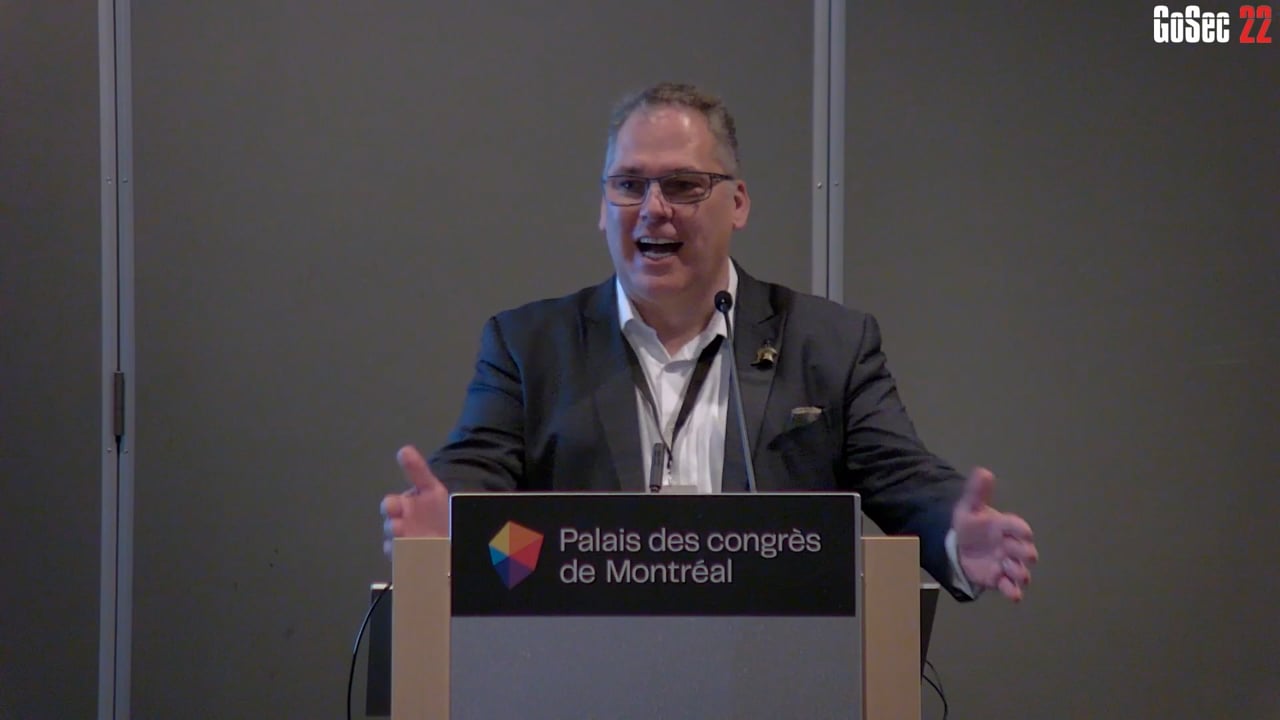
Nicolas Vermeys, lawyer, CISSP and professor at Université de Montréal's law faculty, compresses a two-hour lecture on when social-media content can be collected and admitted as evidence before Canadian and Québec courts. His premise is that the metaverse changes nothing: a Facebook post is 'information carried by a medium', so the same rules apply. He covers reasonable grounds, search warrants versus civil disclosure, the TELUS Supreme Court decision on text messages and the 2019 Criminal Code amendment, then the central question of whether a profile is a private diary or a public space. Reviewing case law, he shows how courts have weighed friend counts (from 400 down to a 'magic' 67), privacy settings, who the friends are and where the account is consulted. Three scenarios follow: public profiles, content obtained through a genuine friend, and hacked private accounts, with the article 2858 balancing test and the 'but for' test as the routes by which illegally obtained evidence still gets admitted. He closes on authentication and integrity, then takes questions on HR investigations, closed groups, undercover officers, Signal screenshots and the Desjardins class action.
Comme plusieurs d’entre nous passent une partie importante de leur vie sur les réseaux sociaux, ces outils constituent une manne potentielle d’éléments de preuve en cas de poursuite, tant en matière civile que pénale. Or, s’il peut être tentant de consulter le profil Facebook ou le compte Instagram d’un tiers dans le cadre d’une enquête, les tribunaux ont, au fil des ans, établi certaines balises quant aux méthodes pouvant être employées pour ce faire. En effet, selon les caractéristiques du profil, les modes d’accès, de collecte et de mise en preuve de contenus autorisés par les tribunaux pourront différer. La présentation fera ainsi état des enseignements pouvant être tirés de la jurisprudence canadienne quant à l’admissibilité en preuve de contenus issus des médias sociaux afin de mieux vous guider dans le cadre de vos enquêtes.
Key takeaways
- Before collecting social-media content for an investigation, document reasonable grounds; in criminal matters obtain the right warrant, since text-message-style exchanges now require an interception authorization.
- Content obtained from a genuine friend of the target is admissible without a warrant, but content obtained by befriending someone under a false identity is not.
- Never log into a private account without authorization, even with a shared password: in criminal law it is unauthorized use of a computer, and the evidence will usually be excluded.
- Capture pages with tools that preserve metadata, not phone photos of a screen; courts reject evidence whose integrity and timing cannot be shown.
- Employer-issued devices carry a lower expectation of privacy; say so in the contract, and remember that a group's 'private' rule binds its members, not third parties who receive the content.
Speakers

Nicolas Vermeys
Nicolas Vermeys, LL. D. (Université de Montréal), LL. M. (Université de Montréal), CISSP, is the Director of the Centre de recherche en droit public (CRDP), the Associate Director of the Cyberjustice Laboratory, and a Professor at the Université de… Read moreRead less
Nicolas Vermeys, LL. D. (Université de Montréal), LL. M. (Université de Montréal), CISSP, is the Director of the Centre de recherche en droit public (CRDP), the Associate Director of the Cyberjustice Laboratory, and a Professor at the Université de Montréal’s Faculté de droit. He is also a visiting professor of law at both William & Mary (USA) and the University of Fortaleza (Brazil). Mr. Vermeys is a member of the Quebec Bar, as well as a certified information system security professional (CISSP) as recognized by (ISC)2, and is the author of numerous publications relating to the impact of technology on the law, including Droit codifié et nouvelles technologies : le Code civil (Yvon Blais, 2015), and Responsabilité civile et sécurité informationnelle (Yvon Blais, 2010). Mr. Vermeys’ research focuses on legal issues pertaining to artificial intelligence, information security, developments in the field of cyberjustice, and other questions relating to the impact of technological innovations on the law. He is often invited to speak on these topics by the media, and regularly lectures for judges, lawyers, professional orders, and government organizations, in Canada and abroad.