
 46:53
46:53This recording is not available yet.
Are your OT, IT, and ET ready for Cyberwarfare?
Download resourcesCategories
About this session
A cyber resilience consultant and ransomware researcher argues that ransomware itself is evolving away from encryption toward faster extortion-as-a-service and outright data destruction, driven partly by AI-generated phishing that has pushed detection advice back toward spotting typos. She traces hacktivism's shift from 1990s open-internet idealism through Anonymous-era anti-authority protest to a new establishment era where activist groups align with nation-state political and geopolitical objectives, using crowdsourced DDoS and social platforms to coordinate globally with limited interaction. The talk's core is operational technology: legacy PLCs and SCADA systems resist modern tooling, retiring staff take manual-fallback skills with them, and critical sectors such as water, power, healthcare and data centers turn out to be tightly interdependent, so one attack cascades widely. Her prescription is layered security: inventory every connected device including consumer IoT, enforce least privilege, separate IT and OT Active Directory domains, tightly manage third-party and AI-agent access, use DMZs and unidirectional gateways, and monitor for behavioral anomalies beyond malware signatures. She closes with an ABC incident-response framework and executive-level guidance on business continuity and communications.
Hacktivism has evolved. Once the tool of anti-Establishment rebels, it has now become a weapon wielded by the
Establishment itself: more organized, more ambitious, and relentlessly escalating since 2023. Today’s attackers
orchestrate large-scale attacks targeting sectors such as government, telecom, energy, hydro, and media, exploiting
their public visibility for maximum impact. In this new era, cyberattacks are no longer just crimes. They are spectacles,
engineered for shock and awe. This meant pivoting to new attacking tricks since ransomware is now the cost of doing
business.
Against this backdrop of shifting hacktivist tactics, APT threats, and Canada’s political landscape, are your OT, IT, and
Engineering Technology truly prepared and tested for cyberwarfare?
This presentation will explore how organizations can build resilience against catastrophic data destruction, starting with
a deep dive into the criminal mindsets and evolving tactics of today’s most motivated adversaries. You’ll learn how to
uncover your systems’ vulnerabilities, prepare for the reality that you may be targeted, and why simply keeping a low
profile is no longer a viable defense. Most importantly, we will examine strategies for rapid recovery to fortify your
operations and protect human life.
Key takeaways
- Inventory every device connected to your OT network, including consumer IoT like smart cameras or thermostats staff bring in; each one is an entry point.
- Keep IT and OT on separate Active Directory domains so a compromise on one side cannot move laterally into the other.
- Map cross-sector dependencies (power, water, healthcare, data centers) before an incident, not during one; a single outage can cascade through partners you don't directly control.
- Train new staff on manual fallback procedures before your most experienced OT operators retire; that expertise disappears with them.
- Run incident-response tabletop exercises regularly so responders already know and trust each other before a real incident, and cut third-party and AI-agent access the moment it's no longer needed.
Speakers

Vicky Desjardins
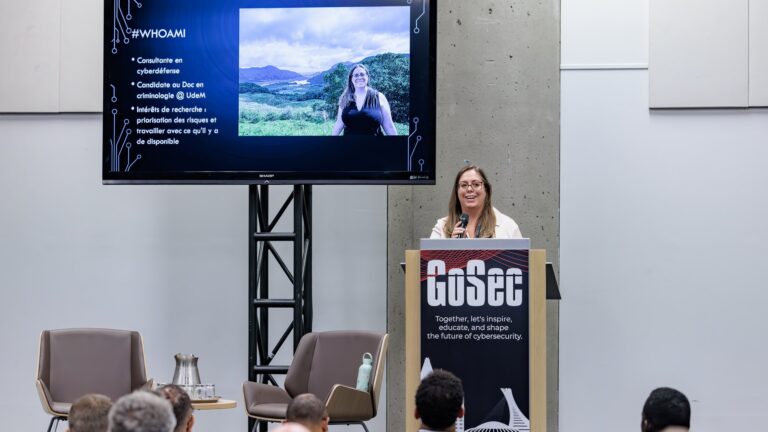
Vicky Desjardins est une candidate au doctorat en criminologie à l'Université de Montréal, spécialisée dans le domaine complexe des méthodologies d'attaques par rançongiciels. Ses recherches doctorales portent sur des stratégies innovantes visant à… Read moreRead less
Vicky Desjardins est une candidate au doctorat en criminologie à l'Université de Montréal, spécialisée dans le domaine complexe des méthodologies d'attaques par rançongiciels. Ses recherches doctorales portent sur des stratégies innovantes visant à perturber de manière préventive les scripts d'attaque, contribuant ainsi de manière significative à l'évolution du paysage de la cybersécurité. Les activités académiques de Vicky comprennent une expertise en matière de priorisation des risques et d'analyse du comportement criminel, enrichie par son mémoire de maîtrise sur la priorisation des cas de sollicitation sexuelle en ligne présentant un potentiel élevé de contact hors ligne. Vicky dirige également la réponse aux cyberincidents, jouant un rôle crucial dans le confinement et la neutralisation des acteurs de la menace, ce qui souligne son expertise pratique dans le domaine.