
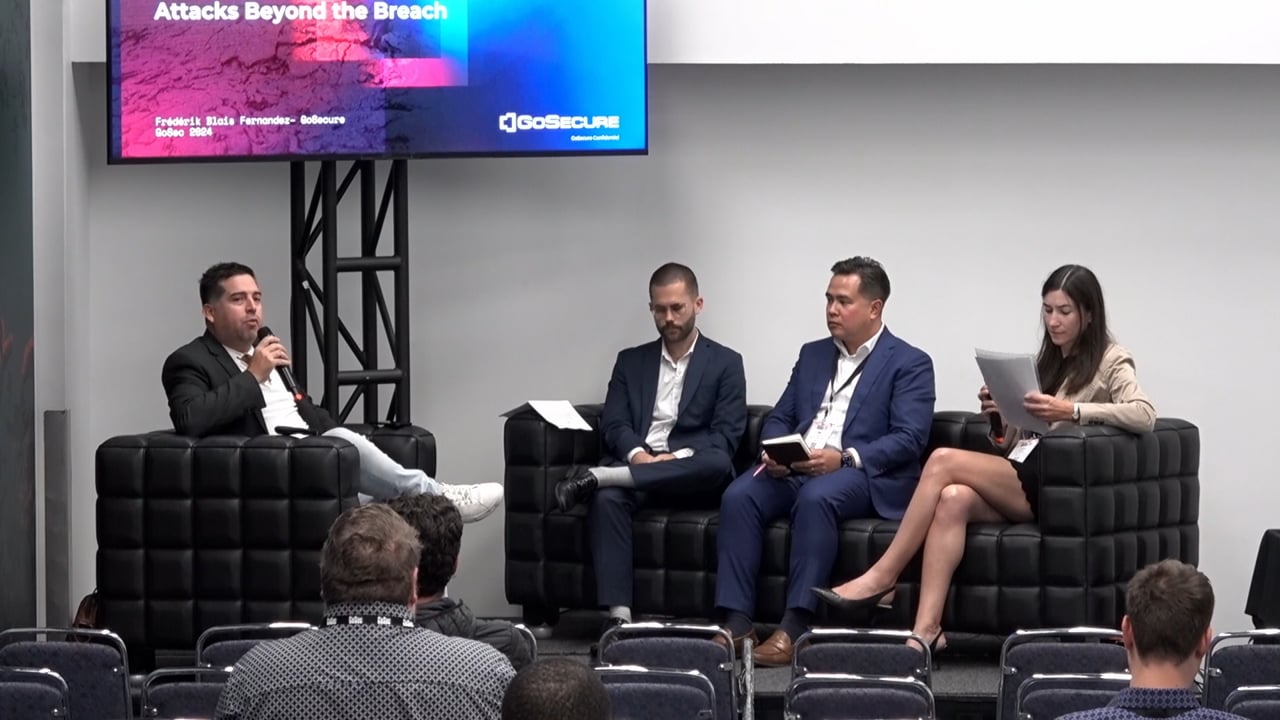
 54:45
54:45This recording is not available yet.
Understanding the risk through red teaming exercise
Download resourcesCategories
About this session
Charles Hamilton, an executive director at KPMG, walks through four real attack techniques used in his red team engagements and, for each, asks the same question: could the target actually detect it. First is Azure device code phishing, where a victim enters a legitimate Microsoft login code, handing the attacker access and refresh tokens that can be extended to read email, download attachments and harvest credentials via the Graph API, largely invisible in default logging. Second is loading an unsigned DLL through a Microsoft-signed .NET executable's config file, evading execution-policy and EDR controls because they inspect the executable, not the accompanying config file. Third is PetitPotam, a still-exploitable technique for coercing domain controller authentication and relaying it, especially when SMB signing is disabled, to fully compromise a domain. Fourth is stealing browser cookies by duplicating a locked file handle to bypass MFA and reach applications like Citrix without touching credentials in memory, avoiding EDR monitoring of processes like LSASS. Throughout, he stresses network visibility and SIEM aggregation as the common defense gap, and closes with audience questions on phishing variants, cookie geofencing workarounds and whether OWASP Top 10 compliance is enough on its own (it is not).
This conference will aim to highlight the importance of Red Team exercises in corporate environment, both from a technical and strategic point of view. We will show why this type of exercise helps identify weaknesses in a complex environment that could be abused by an attacker. On the menu, phishing, session token theft, EDRs evasion, corporate network been compromised and the associated risks. Finally, solutions and detection ideas will be shared.
Key takeaways
- Aggregate Azure/Entra sign-in and Graph API logs into your SIEM; refresh-token scope extension and Graph API queries leave almost no trace in default Microsoft logging.
- Do not assume Microsoft-signed executables are safe by default; check for accompanying .NET config files that can load unsigned DLLs from the internet in memory.
- Enforce SMB and LDAP signing everywhere, including on legacy systems; PetitPotam relay attacks against domain controllers depend on signing being disabled.
- Treat low- and medium-severity findings like 'SMB signing not required' as potentially critical in context; a red team report should explain the chained impact, not just the raw severity.
- Reduce cookie and session lifetimes and disable browser credential caching, since long-lived cookies bypass MFA entirely once an attacker has extracted the browser's decryption key.
Speakers

Charles Hamilton
Charles F. Hamilton has more than 10 years of experience in the field of cybersecurity, primarily recognized for his technical expertise in Red Team exercises and tool development. Known under the pseudonym Mr.Un1k0d3r, he has been providing… Read moreRead less
Charles F. Hamilton has more than 10 years of experience in the field of cybersecurity, primarily recognized for his technical expertise in Red Team exercises and tool development. Known under the pseudonym Mr.Un1k0d3r, he has been providing training and content for several years.