 54:45
54:45This recording is not available yet.
Radical Resilience: Strengthening Data Protection Against Advanced Cyber Threats
Download resourcesCategories
AI & Emerging TechnologyGovernance, Risk & LeadershipCompliance & RegulationCyber InsurancePrivacy & Data Protection
Vendors and tools discussed
Sponsored by
About this session
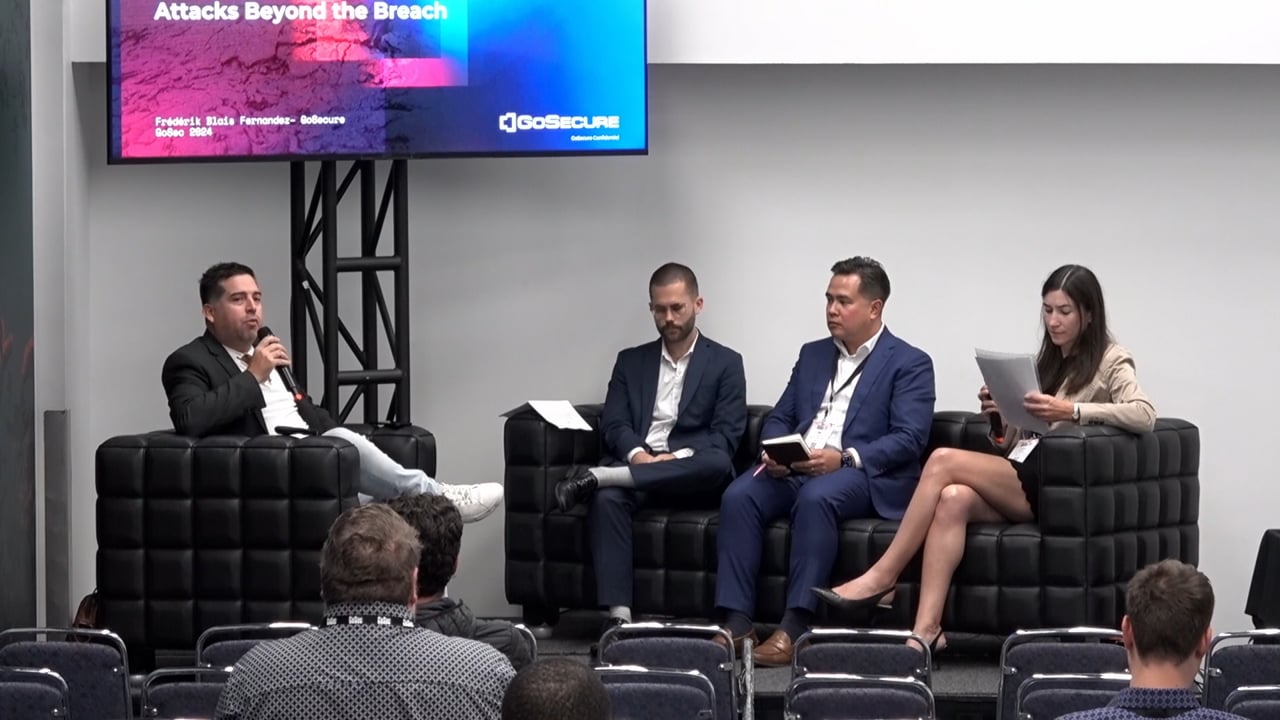
Eric Amar, a systems engineer at Veeam Software, delivers a French-language sponsor talk on data resilience even though the site lists the session in English. He opens with figures on exploding data volumes, multicloud sprawl and ransomware: Canada ranks third worldwide for breach frequency per IBM's annual Cost of a Data Breach report, and only 27 percent of ransom-paying victims actually recover their data, which he uses to argue for immutable, tested backups rather than trust in attackers. Through an extended Despicable Me Minions analogy, he covers Veeam's approach: immutable storage, multi-factor authentication, a four-eyes approval rule citing a Verizon finding that 20 to 23 percent of attacks are insider-driven, source-based licensing, AI-powered malware scanning, and YARA rules that scan backup content for known threat signatures instead of relying on virus definitions alone. He ties this to Quebec's Law 25 and Law 15 and to increasingly technical cyber-insurance questionnaires, demos Veeam's Threat Center dashboard for automated, auditable disaster-recovery testing, and cites Veeam's acquisition of Coveware for post-incident forensics and decryption. He closes with a widely reported case of a company wiring 22 million dollars after a video call was faked with AI to impersonate its CFO and CEO.
In this presentation, we will address the growing challenge of maintaining data confidentiality, authenticity, and availability in an era where data is expanding exponentially. With 90% of the world’s data created in the last two years, the threat landscape has intensified, especially with AI making ransomware attacks more sophisticated and harder to prevent. Despite significant investments in security, the risk of a single breach remains high, with 43% of data potentially unrecoverable post-attack. This highlights the urgent need for a robust data resilience strategy.
We will explore how ransomware recovery requires a different approach than traditional disaster recovery, emphasizing the importance of coordinating IT and Security teams effectively. Veeam’s new capabilities are designed to help your teams transition to Radical Resilience, ensuring your business remains operational even in the face of advanced cyber threats.
Key takeaways
- Do not assume paying a ransom restores your data; only about 27% of victims who pay actually recover it, so invest in tested backups instead of negotiation as the primary plan.
- Make backup storage immutable and require multi-factor authentication plus a four-eyes approval step for destructive actions, since 20 to 23% of successful attacks originate from insiders.
- Test disaster-recovery plans on a real schedule, not just document them; automate the test and its audit trail so proof is ready for cyber-insurance and compliance reviewers.
- Scan backup content itself for threat indicators (such as YARA rules) rather than relying only on signature-based antivirus, since attackers specifically target backup infrastructure to block recovery.
- Treat AI-driven deepfake fraud as a live payment-approval risk: a reported case shows a company wiring 22 million dollars after a faked video call impersonating its CFO and CEO.
Speakers
Eric Amar
Eric Amar possesses over twenty years of professional experience in pre-sales and architecture, specializing in teleconferencing, IP telephony, networking, servers, data protection, storage, cloud, and virtualization solutions. Throughout his… Read moreRead less
Eric Amar possesses over twenty years of professional experience in pre-sales and architecture, specializing in teleconferencing, IP telephony, networking, servers, data protection, storage, cloud, and virtualization solutions. Throughout his career, Mr. Amar has developed a comprehensive expertise in designing end-to-end solutions, considering both the technical intricacies and business impacts. He has also honed his skills in business, marketing and sales strategies, effectively managing sales and project cycles for small and medium-sized enterprises, as well as governmental, national, and international organizations.